Projects & Experiments
Hands-on side projects, virtual processor & hardware emulation journeys, custom game engines, and low-level memory-layout experiments.
Filtering projects & experiments by label: Rust
Clear filter
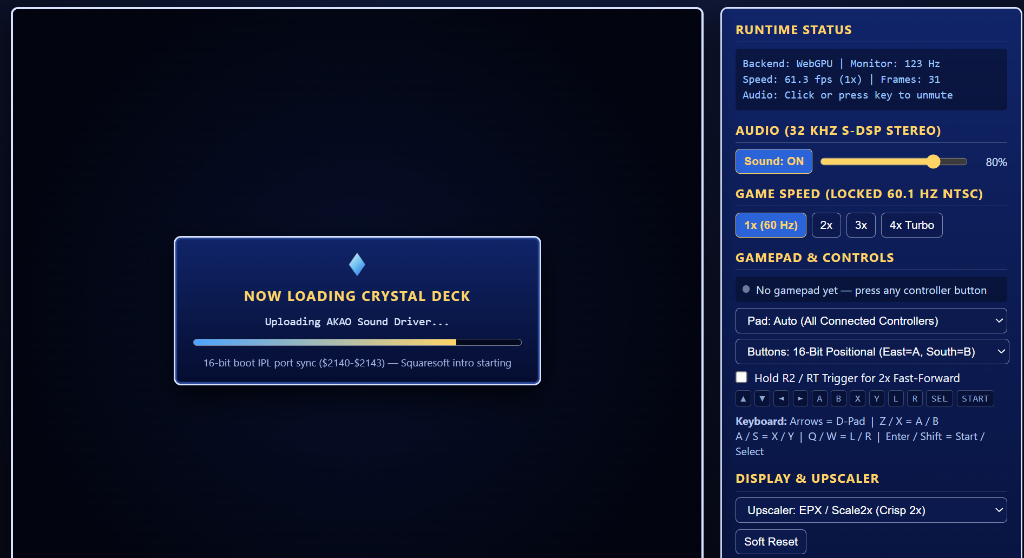
Emu16Bit — 16-Bit WebAssembly Emulator
Last modified:
My journey learning Rust—building on the low-level memory layout and machine-instruction experiments in my HPC Recursive DFS Series—sparked a deep dive into 16-bit CPU opcodes, instruction dispatching, and virtual processor design, turning into a 16-bit WebAssembly emulator.
- Steps through 16-bit 65C816 opcodes using fast table-driven instruction dispatching
- Stores RAM, video memory, and banked buses in flat, contiguous Rust arrays
- Acts like a virtual processor—fetching, decoding, and running guest bytecode
- Compiles to sandboxed WebAssembly binary code that stays safe and hard to reverse engineer
● 3D Figure-8 · Ring Recursion
Paused · Hover to resume
Rust WASM · WebGL 2.0

Recursion Forever
Last modified:
Proving you can make recursive calls at bare-metal speed with an optimized, hardware-level memory footprint—scaling past 3 trillion depths on a Raspberry Pi 5 driving a physical 5-DOF robotic arm in real time (finale of my HPC Recursive DFS Series).
- Lowers recursive functions via compile-time defunctionalization ([DefunctionalizeDfs]) into a zero-allocation register machine (ΔSP = 0)
- Scales past 3+ trillion states on an 8 GB Raspberry Pi 5 using CPU-cache ring buffers and NVMe-streamed 1-bit slabs (~750× less RAM than Part 3)
- Drives a physical 5-DOF robotic arm at 50 Hz over UART + UDS IPC with zero GC pauses alongside an interactive Rust WASM + WebGL 2.0 3D simulator